Context
High-integrity contributions to Nature-Positive require offshore wind projects to understand how to put effective approaches into practice at the site level. This means offshore wind projects going beyond biodiversity safeguards and ‘impact reduction’ approaches to deliver measurable and sustainable improvements to the state of nature.
For projects, practical challenges include understanding how to frame and measure loss associated with site-level development impacts; and understanding the scope and scale of positive actions needed to achieve measurable outcomes. In the marine environment, challenges can be heightened due to difficulties with measurement, data availability, dynamism and variable interconnected spatial and temporal scales, that often add complexity compared with operations on land.
Selecting and applying appropriate site-level metrics that help to underpin losses and any net gains from positive action is far from straightforward, as is relating them to the emerging consensus on metrics intended to measure Nature-Positive outcomes. Without a common framework for practical application of approaches at the site level, these problems are compounded.
Why was the OWNPC Framework developed
This Framework was developed to establish how offshore wind projects can credibly deliver measurable Nature-Positive contributions at site level, addressing key challenges that may undermine or limit intent in achieving such outcomes. Progress is rarely achieved by repeating approaches that are not delivering the outcomes we seek. Instead, it comes from re-focusing where effort is directed and re-thinking how established concepts are applied to the specific goal being sought, building on lessons and experience.
For a long time, delivering a net positive impact outcome for marine biodiversity has been perceived as too difficult. Often, the underpinning concepts behind that view are carried over from land-based approaches, and these may be less fit-for-purpose when applied in the marine realm. What is determined as complexity in the marine environment is often just difference that limits the application of land-based approaches or requires an alternative way of doing things.
How the OWNPC Framework works
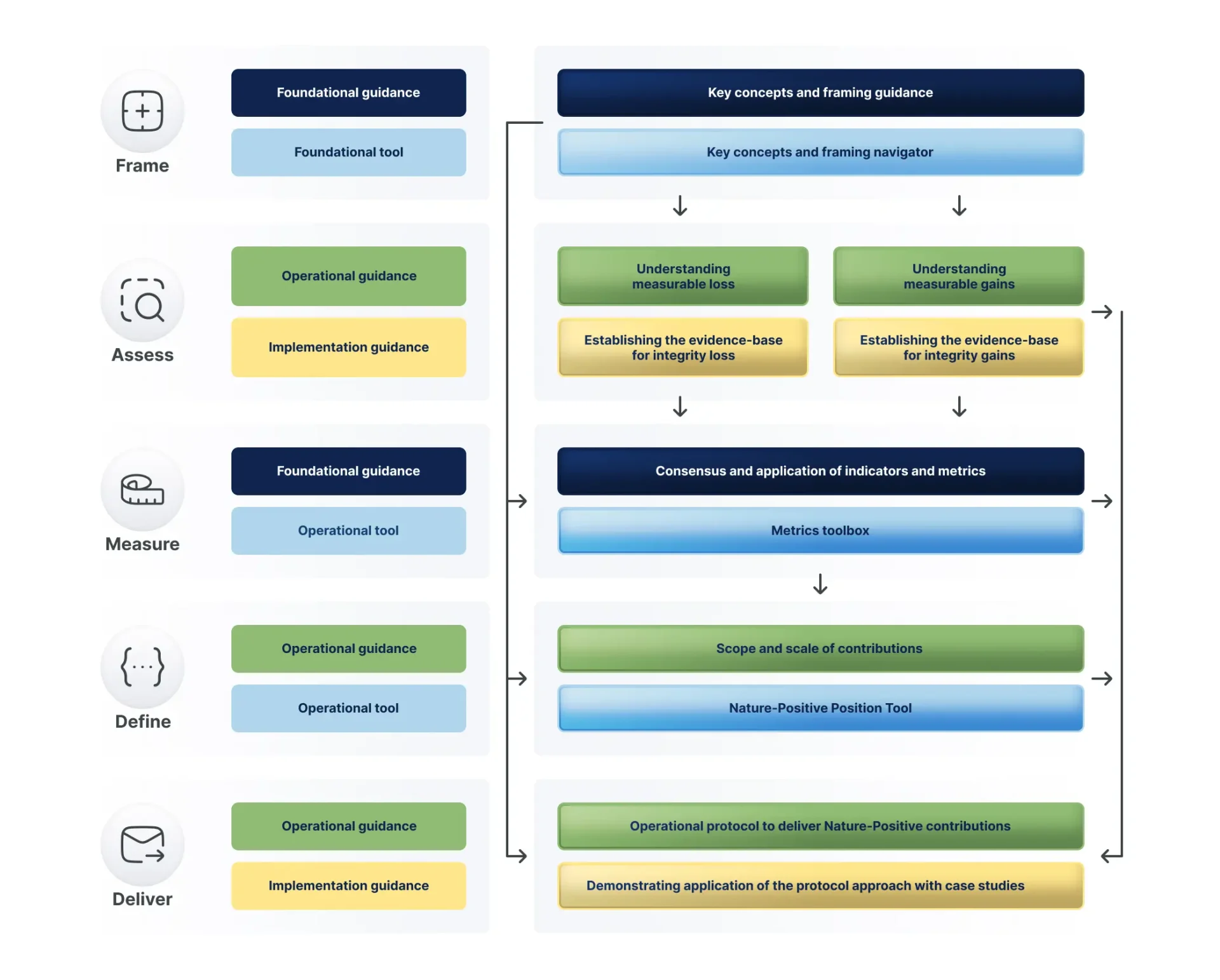
The five-stage Framework helps offshore wind projects deliver measurable Nature-Positive contributions at site level by providing the guidance needed to:
- Frame: align with the key concepts that support the achievement of measurable Nature-Positive contributions.
- Assess: define losses and gains in a meaningful and measurable way in the context of Nature-Positive outcomes.
- Measure: select, prioritise and apply metrics that measure Nature-Positive contributions.
- Define: determine the scope and scale of actions and outcomes that deliver Nature-Positive contributions.
- Deliver: understand how to operationalise and implement approaches that deliver Nature-Positive contributions.
At its core of the Framework is the need to frame loss and gain relating to a meaningful change to feature integrity defined at an ecologically appropriate scale. The Framework helps a project understand measurable loss and measurable gain, aligns the metrics they already use with an emerging consensus on which can detect integrity change, and provides an interactive Metrics Toolbox. It defines the scope and scale of a contributions through a Nature-Positive Position Tool and draws everything together in an operational State-Pressure-Response protocol which shows how the whole approach can be implemented.